
The EIBOR rate today stands at 3.75% for one month and 3.95% for three months, with the one-year rate at 4.30%, published by the Central Bank of the UAE at its latest fixing, dated 14 August 2026.
If you hold a variable-rate mortgage in Dubai or Abu Dhabi, or you are about to apply for one, those are not abstract percentages. One of them, plus a fixed margin your bank wrote into your contract, is what your monthly payment is built from. Most people signing a home loan in Dubai never look the number up. This guide is the lookup, plus the arithmetic that hangs off it.
What EIBOR actually is
EIBOR, the Emirates Interbank Offered Rate, is the benchmark cost of dirham lending between UAE banks. A panel of banks submits rates each business day, the Central Bank administers the process, and the result is published for six tenors, from overnight money out to one year.
The full curve at the current fixing:
| Tenor | EIBOR, 14 August 2026 fixing |
|---|---|
| Overnight | 3.44% |
| 1 week | 3.70% |
| 1 month | 3.75% |
| 3 months | 3.95% |
| 6 months | 4.01% |
| 1 year | 4.30% |
Two of those tenors do almost all the mortgage work. Variable home loans in the UAE typically reprice off 1-month or 3-month EIBOR, so those are the numbers to watch, not the overnight rate that headlines sometimes quote.
The dirham is pegged to the US dollar, so UAE rates track the American rate cycle closely. When US rates move, EIBOR follows the same direction, which is why a decision taken in Washington shows up, a few steps later, in a Dubai mortgage payment.
How EIBOR reaches your monthly payment
A typical UAE mortgage has two phases. The first two or three years run at a fixed promotional rate. After that, the loan reverts to a formula: EIBOR plus a fixed margin, recalculated at each reset. The margin is agreed at signing and does not move. EIBOR does.
This is why nobody can honestly quote you a single figure for mortgage rates UAE wide. The fixed-period offers differ bank to bank and month to month, and the reversion rate is a formula, not a number. What is knowable, precisely and for free, is the benchmark underneath every one of those formulas. That is the number above.
It is also why two neighbours with the same apartment can pay differently: one signed a wider margin, or their loan resets on a different tenor. When you compare offers, the margin after the fixed period matters at least as much as the teaser rate, because you will live with it for twenty years and it is the part EIBOR multiplies against.
What the arithmetic does to AED 1,000,000
Rules first, then numbers. The Central Bank caps the term at 25 years and caps repayments at half of gross income, and an expat's first home under AED 5M can borrow up to 80% of the price. Those rules were covered in detail in our off-plan mortgage guide; here they are the frame for the payment math.
On a 25-year term, each AED 1,000,000 borrowed costs, per month:
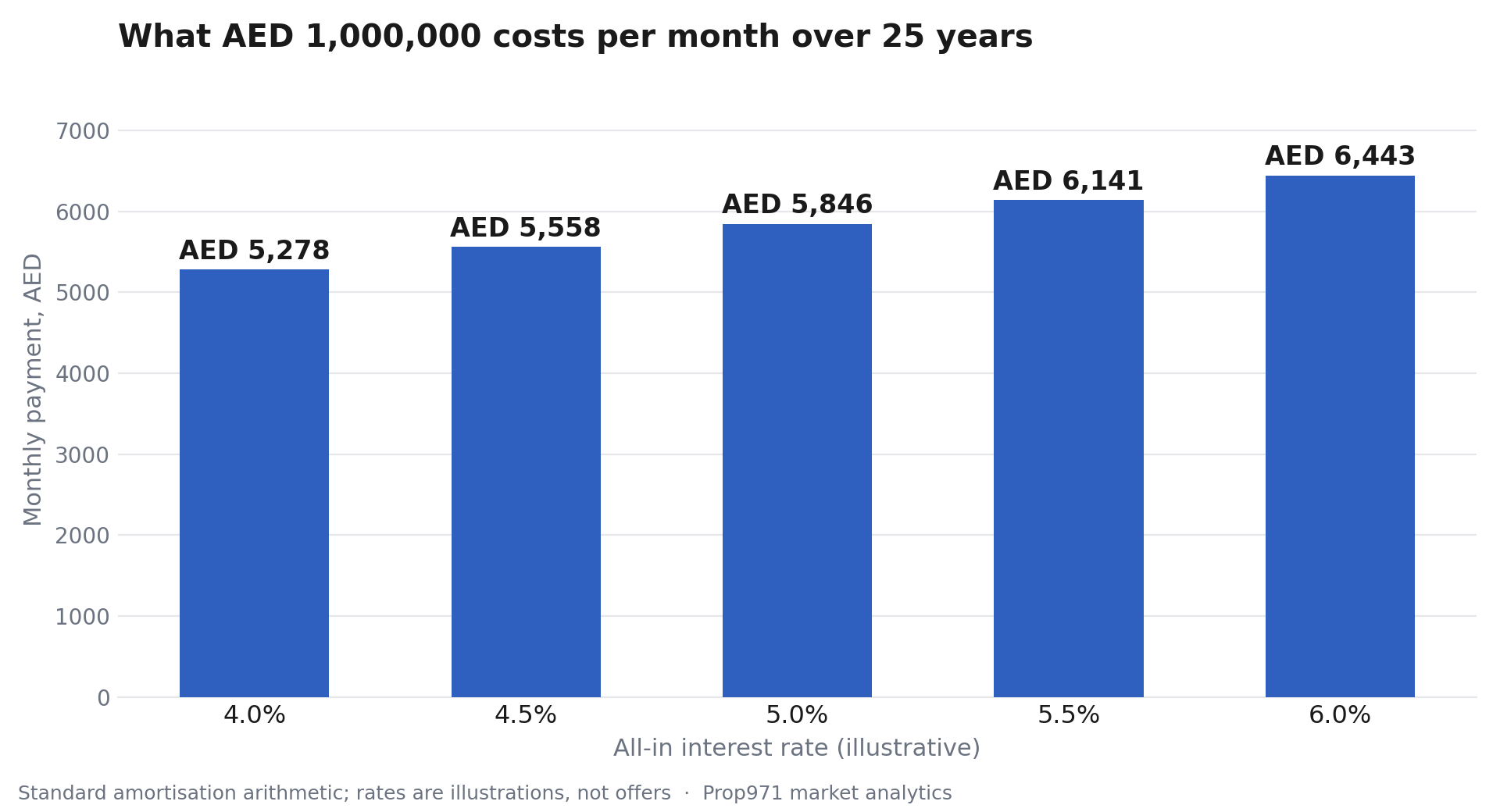
Read that chart as a sensitivity dial, not a menu. At 4.0% the payment is AED 5,278 per million; at 6.0% it is AED 6,443. The two-point spread costs AED 1,165 a month per million, a 22% difference, on identical debt. Roughly AED 291 per half-point is a number worth memorising, because it converts any rate conversation into dirhams instantly.
The salary the math demands, district by district
Here is the same arithmetic pointed at real prices. Take the median ready two-bedroom sale over the last twelve months in four of Dubai's most liquid districts, assume the expat first-home structure of 20% down and 80% borrowed, price the loan at an illustrative 5.0% over 25 years, and apply the Central Bank's rule that all debt payments together cannot pass half of gross income. The result is the minimum salary the regulation implies, assuming no other borrowing:
| District | Median ready 2-bed, 12 months | Loan at 80% | Monthly payment at 5%, 25y | Salary implied by the 50% cap |
|---|---|---|---|---|
| Jumeirah Village Circle | AED 1,500,000 | AED 1,200,000 | AED 7,015 | AED 14,030 |
| Business Bay | AED 2,350,000 | AED 1,880,000 | AED 10,990 | AED 21,981 |
| Dubai Hills | AED 2,528,985 | AED 2,023,188 | AED 11,827 | AED 23,655 |
| Dubai Marina | AED 2,800,000 | AED 2,240,000 | AED 13,095 | AED 26,190 |
That range is the useful finding: a two-bedroom mortgage in Jumeirah Village Circle clears the affordability rule at roughly AED 14,000 a month, while the same flat in Dubai Marina needs about AED 26,200, with Business Bay and Dubai Hills in between. Same rules, same rate, same bedroom count; the district does the rest.
Any mortgage calculator Dubai banks publish runs this identical formula. The difference here is that the property prices are medians from the actual sale registry, not a slider you drag optimistically.
Two honest caveats. The 5% is an illustration chosen inside the current plausible band, not a quote; reprice the table mentally by AED 291 per half-point per million. And a bank will deduct existing car loans and card limits from that half-of-income budget before your mortgage gets what is left, so the salary column is a floor, not a promise.
Watching EIBOR like a buyer, not an economist
Three practical habits, none of which require a finance degree.
Check the fixing before you sign, not after. The Central Bank publishes it daily. Knowing the current 3-month rate turns "attractive rate" claims into arithmetic you can check at the kitchen table.
Ask which tenor your loan resets on, and how often. A 1-month reset tracks the benchmark quickly in both directions; a 3-month reset moves in steps. Neither is better, but you should know which one you are holding.
Stress-test yourself two points up. Before committing, run your payment at your reversion margin plus EIBOR plus two percentage points. If the number breaks your budget, the loan is too large regardless of what today's fixing says. The chart above makes that a ten-second calculation.
One buyer, end to end. Take the Jumeirah Village Circle median from the table: AED 1,500,000, so AED 300,000 down and AED 1,200,000 borrowed. At the illustrative 5% the payment is AED 7,015 and the rule wants AED 14,030 of monthly income behind it. Now run the stress test: at 7%, the same loan costs AED 8,482 a month and demands AED 16,963 of income. If your salary clears the second number, the flat is affordable in both worlds; if it only clears the first, you are betting your home on the rate cycle staying friendly. That, in one paragraph, is why the EIBOR fixing deserves thirty seconds of your attention before any signature.
Rates, prices and the fees around them all live in one place on our market dashboard, and the registry both of these tables come from is the Dubai Land Department.
FAQ
What is the EIBOR rate today?
1-month EIBOR is 3.75%, 3-month is 3.95% and 1-year is 4.30% at the Central Bank of the UAE's latest fixing, dated 14 August 2026; the rate is published every business day. Variable UAE mortgages typically reprice off the 1-month or 3-month tenor plus a fixed bank margin.
How often does EIBOR change?
It is fixed every business day, but your mortgage only feels it at reset dates, monthly or quarterly depending on the tenor your contract references.
What is the minimum salary for a home loan in the UAE?
Regulation sets no salary floor; banks set their own, and the binding rule is the Central Bank's cap of all debt payments at 50% of gross income. On registry medians, a ready two-bedroom implies roughly AED 14,000 a month in Jumeirah Village Circle and about AED 26,200 in Dubai Marina at an illustrative 5% rate.
Can a non resident get a mortgage in Dubai?
Yes, some UAE banks lend to non-residents at their own discretion, usually with larger down payments and shorter terms than resident loans. The Central Bank's published caps address residents; non-resident terms are each bank's own policy, so they vary widely.
Is a fixed or variable rate better in the UAE?
Neither is universally better. Fixed buys certainty for its period; variable follows EIBOR both ways. What matters most is the margin and tenor you revert to after the fixed years, because that formula governs most of the loan's life.
Why do UAE rates follow US rates?
The dirham is pegged to the US dollar, so the Central Bank's policy rate moves with the US rate cycle to defend the peg, and EIBOR, the interbank rate built on top, follows.
References
EIBOR figures are the Central Bank of the UAE's published fixing for 14 August 2026. Property figures are computed from official transaction records (DLD) via Prop971 market analytics, including transactions up to 14 August 2026. Payment figures are standard amortisation arithmetic at labelled illustrative rates, not lending offers.