

Over the last twelve months, Dubai apartments sold at a median of about AED 1,738 per square foot. Villas sold at about AED 1,722.
A one percent gap. On the face of it, the most useful comparison in property has just told you that the villa and the apartment cost the same, and you should therefore buy whichever you prefer.
That conclusion is wrong, and the number that produced it is one of the most quietly misleading figures in Dubai property.
What the average is actually averaging
Dubai's citywide median is about AED 1,738 per square foot across roughly 166,000 residential sales in the last twelve months. The mean is AED 1,933, about 11% higher, because a handful of very large sales drag it upward. That gap between mean and median is the first clue that a single number is doing a lot of work here.
The bigger problem is what sits inside it. Split the same sales by property type and the mix is not remotely comparable:
Apartments are 71% studios and one-bedrooms. Villas are 81% three and four-bedrooms.
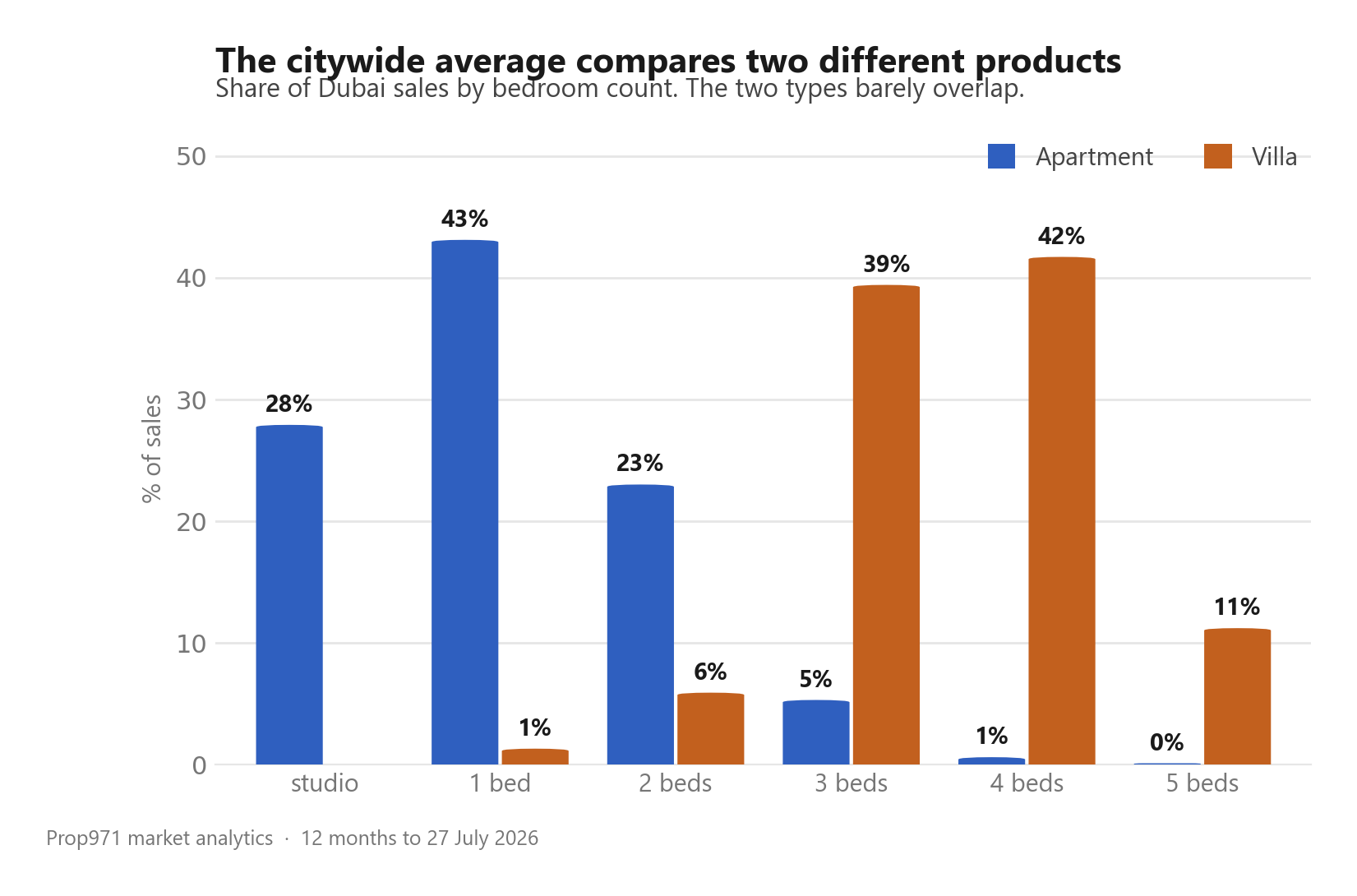
These are not two versions of the same product priced against each other. They are two different markets that happen to be measured in the same unit. Averaging them produces a number that describes neither.
Match them bedroom for bedroom and the parity vanishes
Compare like with like and villas are cheaper per square foot at every single bedroom count in Dubai:
- One bedroom: apartments AED 1,643, villas AED 1,358. Villas 17% cheaper
- Two bedrooms: apartments AED 1,824, villas AED 1,427. Villas 22% cheaper
- Three bedrooms: apartments AED 2,189, villas AED 1,836. Villas 16% cheaper
- Four bedrooms: apartments AED 2,856, villas AED 1,693. Villas 41% cheaper
- Five bedrooms: apartments AED 4,517, villas AED 1,572. Villas 65% cheaper
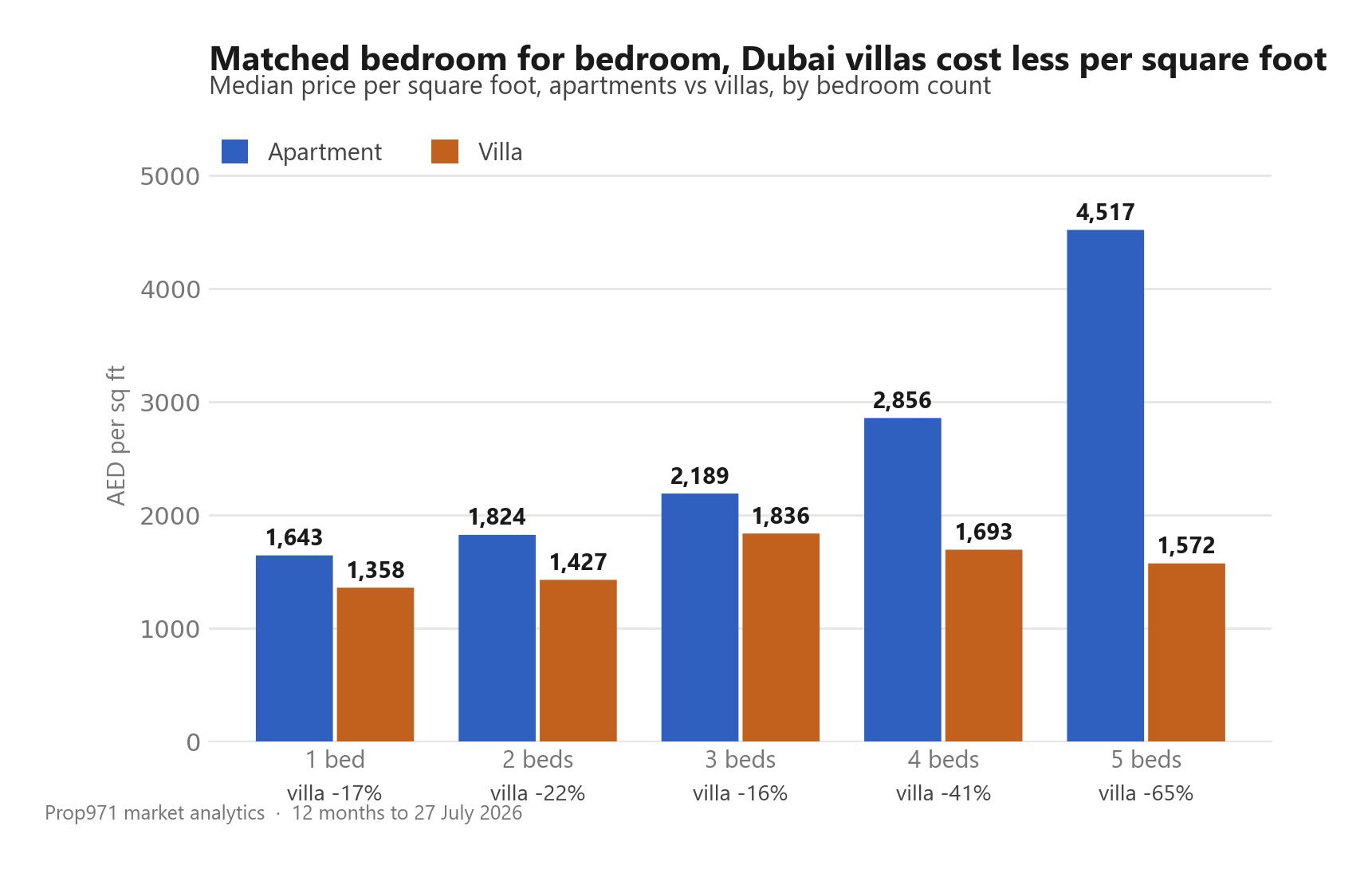
Notice what apartments do as they get bigger. Price per square foot climbs from 1,643 to 4,517, because a five-bedroom apartment in Dubai is not a family flat, it is a penthouse in a prime tower. Villa pricing barely moves across the same range.
So the citywide parity is an accident of arithmetic. Villas skew toward the bedroom counts where apartments are most expensive per foot, and the two errors cancel. Remove the mix and the villa discount is there at every level.
The four and five-bedroom gaps deserve a caveat: those apartment samples are small, 984 and 124 sales, and they are concentrated in a handful of prime addresses. At one to three bedrooms, where the samples run into tens of thousands, the discount still holds at 16 to 22%.
Then compare within a district and it stops holding
Here is where the tidy story breaks, which is usually where the useful part starts.
Take only districts where both apartments and villas sold in volume over the last twelve months, and villas are cheaper per square foot in six of fifteen. Not most. Fewer than half.
The range is enormous. In Al Hebiah Fifth villas trade 21% below apartments. In Me'Aisem First they trade 110% above. Same city, same metric, opposite answers.
And notice the sample: fifteen districts out of 145. In 90% of Dubai, one type or the other simply does not trade in meaningful numbers. Villas and apartments are not competing for the same buyer in the same place. They occupy different parts of the map.
Which means the citywide villa-versus-apartment comparison is not measuring a price difference at all. It is mostly measuring geography.
What actually differs: the cheque, not the rate
Strip out the per-square-foot framing and the real difference is unmissable.
Median Dubai villa: AED 3.52 million. Median apartment: AED 1.28 million. The villa costs 175% more.
It is also 144% bigger: 1,908 square feet against 781.
That is the honest summary of the choice. You are not paying a higher rate for a villa. You are buying roughly two and a half times the floor area at a similar rate, and writing a much larger cheque for it.
The four-bedroom comparison makes the point uncomfortably well. A four-bedroom apartment in Dubai has a median price of AED 10.2 million. A four-bedroom villa: AED 3.6 million. The villa has more space and costs a third as much, because the apartment is a penthouse and the villa is in a suburban community. Same bedroom count, entirely different product.
None of which appears in a per-square-foot table. Seeing where a specific project sits inside its own district, rather than against a citywide average, is what our market analytics are for.
Dubai Marina, Downtown Dubai, and why district beats city
The citywide figure also flattens the only comparison that reliably matters, which is between one location and another.
Over the last twelve months:
- Downtown Dubai: about AED 2,922 per square foot
- Business Bay: about AED 2,593
- Dubai Marina: about AED 2,365
- Palm Jumeirah: about AED 3,588
Against a citywide median of 1,738, every one of these is a different market. And within Business Bay alone, individual project medians run from about AED 1,399 to AED 4,252 – a threefold spread inside one district.
So "the average price per square foot in Dubai" is arithmetically true and practically useless for judging any specific unit. The district median is the number that tells you whether an asking price is ordinary or ambitious, and the project's own position within that district is the number that tells you why.
Abu Dhabi runs the control experiment
If the Dubai parity really is a coincidence of mix rather than a market fact, then the same comparison in a different market should not produce parity. It does not.
In Abu Dhabi over the last twelve months, apartments sold at a median of about AED 1,840 per square foot and villas at about AED 1,468. Villas are 20% cheaper, with no parity anywhere in sight.
The size gap is far more extreme too. The median Abu Dhabi villa costs AED 6.14 million across 4,476 square feet. The median apartment costs AED 1.95 million across 1,036. That is a villa market built around large family homes rather than a continuum with apartments at one end.
Two emirates, the same question, opposite answers. Which is the strongest evidence that the Dubai number was never telling you about villas and apartments in the first place.
One number that genuinely does differ by type
Buried under all this is a comparison that survives the mix problem, because it holds property type constant and varies only the construction stage.
In Dubai, apartments carry an off-plan premium of about 31%: AED 1,822 per square foot off-plan against AED 1,387 for finished stock. Villas carry only about 16%: 1,772 against 1,528.
In Abu Dhabi both sit near 40%.
That is a real, like-for-like finding: in Dubai you pay noticeably more of a premium to buy an unbuilt apartment than an unbuilt villa.
Which raises the question the premium is actually about. You are paying it for a building that does not exist yet, so the thing worth knowing is how far along it is, and that is nowhere in a price table. It sits with the regulator, in a completion percentage that most buyers never look up. Our project pages put it directly under the promised handover date, because a project promising keys in eighteen months at single-digit completion is telling you two things at once.
How to use price per square foot properly
The metric is not broken. It is just being asked to answer a question it cannot.
- Never compare across property types citywide. The mix decides the answer, not the market.
- Compare within a district, and within a bedroom count. Both, not either.
- Check the sale count. A median from a handful of transactions is an anecdote in a suit.
- For the buy-or-not decision, use total price and size. Price per square foot tells you whether the rate is fair. It does not tell you whether you can afford the thing or whether it fits your family.
Used that way it is the most useful number in property. Used as a citywide headline it mostly tells you which property types happened to sell that year.
FAQ
What is the average price per square foot in Dubai?
About AED 1,738 per square foot, the median across roughly 166,000 residential sales in the twelve months to July 2026. The mean is higher at about AED 1,933 because large transactions pull it upward, which is why the median is the more reliable figure. Both flatten enormous variation: Downtown Dubai runs near AED 2,922 and Palm Jumeirah near AED 3,588.
Are villas cheaper than apartments per square foot in Dubai?
Citywide they look identical, about AED 1,722 for villas against AED 1,738 for apartments, but that parity is a mix artifact. Matched bedroom for bedroom, Dubai villas are 16 to 65% cheaper per square foot. Compared within the same district the picture is mixed, with villas cheaper in only six of the fifteen districts where both types trade in volume.
What is the price per square foot in Dubai Marina?
About AED 2,365 per square foot over the twelve months to July 2026, against a citywide median near AED 1,738. Nearly all Dubai Marina sales are apartments, so the district figure is effectively an apartment figure.
What is the price per square foot in Downtown Dubai?
About AED 2,922 per square foot over the same period, the highest of the major central districts apart from Palm Jumeirah at roughly AED 3,588. Business Bay sits between them at about AED 2,593.
Why is a Dubai villa more expensive than an apartment if the rate is the same?
Because you are buying more space, not a higher rate. The median Dubai villa is 1,908 square feet against 781 for an apartment, 144% larger, which produces a median price of AED 3.52 million against AED 1.28 million. The per-square-foot rate is similar; the cheque is 175% bigger.
Does the same pattern hold in Abu Dhabi?
No, and that is what confirms the Dubai figure is a coincidence. In Abu Dhabi apartments sold at about AED 1,840 per square foot and villas at about AED 1,468, so villas are 20% cheaper with no parity at all. The median Abu Dhabi villa is also far larger, 4,476 square feet at AED 6.14 million.
References
Figures in this article are computed from official UAE property transaction records (DLD, ADREC) via Prop971 market analytics, including transactions up to 27 July 2026.