
Most people buying property in Dubai this year will not receive a title deed at purchase. Over the last twelve months 76.4% of registered Dubai sales were off-plan, and an off-plan purchase does not produce a title deed. It produces an interim registration, and the deed arrives years later when the building does.
That is not a warning. Off-plan is a normal, regulated way to buy here, and it is how most of the market now operates. But the title deed is the document that proves you own something, and it is worth knowing exactly when you get one, what it says, and what the alternative looks like in the meantime.
What is a title deed
A title deed is the ownership certificate issued by the Dubai Land Department, the government body that registers property in the emirate. It is the legal answer to the question of who owns a specific unit. Nothing else settles it. Not the sales agreement, not the payment receipts, not the handover email.
The deed itself is short. It carries the owner's name, the deed number and issue date, the property's location and plot reference, its size, its type, and the nature of the ownership. That last field is the one people skim past and should not.
Freehold property in Dubai, and what leasehold means instead
The ownership field on a Dubai title deed will usually say freehold or leasehold.
Freehold means you own the property and the land under it, with no time limit, and you can sell, lease or leave it to someone. Foreign nationals can buy freehold in designated areas of Dubai, which is the arrangement that made the city's property market what it is.
Leasehold means you own the right to use the property for a fixed term, commonly up to 99 years, while the land stays with its original owner. At the end of the term the property reverts. A 90-year-old leasehold and a freehold look identical from the balcony and are very different assets.
Two other categories appear less often. Usufruct is a long-term right to use and profit from a property you do not own, and musataha is a right to build on land belonging to someone else for a set period. Both behave more like long leases than ownership.
Which areas are designated for foreign freehold ownership is set by law rather than by market convention, and the list has been extended more than once. The Dubai Land Department publishes the current position, and the UAE government's own guidance on expatriates buying property sets out how the rules differ by emirate. Check there rather than in a brochure, because a brochure has a reason to be optimistic.
The document most Dubai buyers actually get first
Buy an apartment that is finished and the transfer produces a title deed. Buy one that is not built yet and it produces an Oqood, the interim registration that records an off-plan purchase against the project until completion. It protects your position and it is registered with the same authority. It is simply not a deed, because the thing it would describe does not exist yet.
The scale of this is the part nobody quotes. Of 164,231 registered Dubai sales in the last twelve months, 125,397 were off-plan. Ready homes, the ones that come with a deed at transfer, accounted for 38,834 sales, or 23.6% of the market.
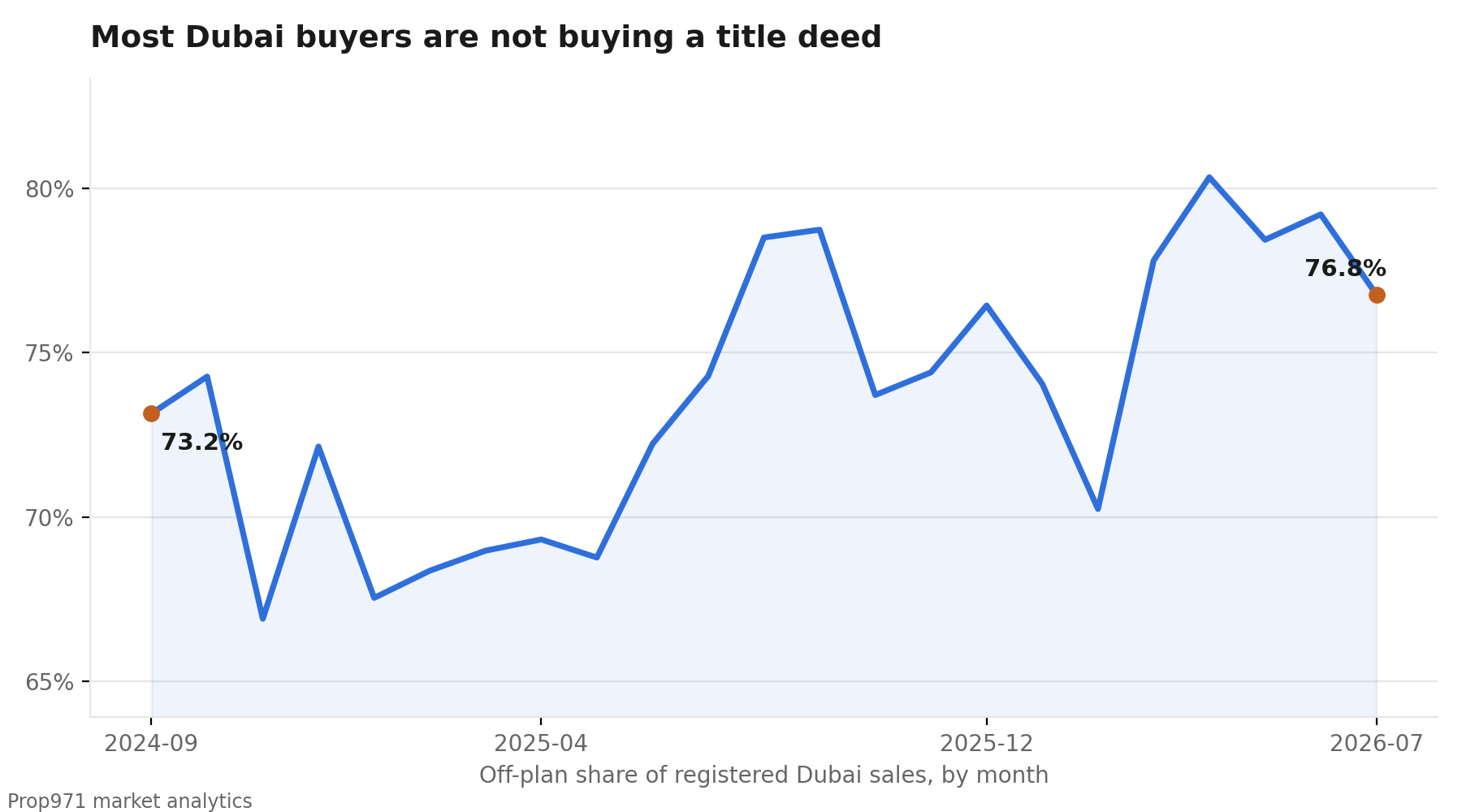
The share is also moving. In the twelve months before this one, ready homes were 28.9% of sales on 48,130 transactions. This year that fell to 23.6% on 38,834. The deeded end of the Dubai market did not just lose share, it shrank by around 9,300 sales in a single year while the market overall grew.
Abu Dhabi runs the same way, slightly further along. Across 28,047 registered sales in the last twelve months, 79.9% were off-plan and 5,644 were ready. Freehold ownership for foreign nationals in Abu Dhabi works through designated investment zones rather than the same district list Dubai uses, so the areas differ even though the document does not.
Where the deeded stock actually is
If a title deed on completion day matters to you, the practical consequence is that you are shopping in less than a quarter of the market, and that quarter is not spread evenly.
Of the 75 Dubai districts with at least 400 registered sales in the last twelve months, 59 had at least 100 ready sales, so most established districts do have a functioning secondary market. But the range is extreme. Six of those districts recorded no ready sales at all, not one, because they are new communities where nothing has been standing long enough to resell. In others, ready stock is almost the entire market.
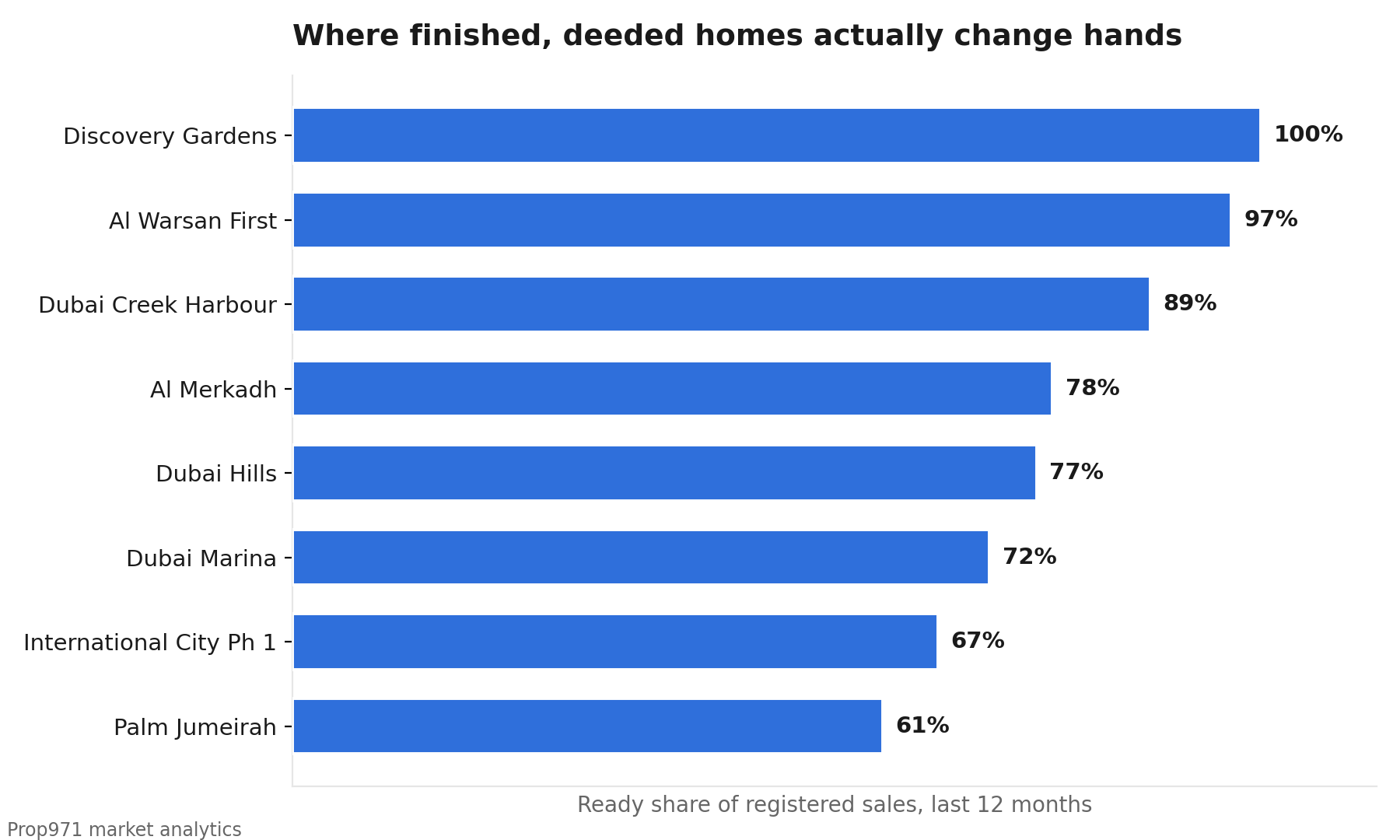
| District | Ready share of sales | Ready sales (12m) | Median ready price |
|---|---|---|---|
| Discovery Gardens | 100% | 506 | AED 745,000 |
| Al Warsan First | 97% | 856 | AED 410,000 |
| Dubai Creek Harbour | 89% | 528 | AED 2,445,000 |
| Al Merkadh | 78% | 1,212 | AED 1,250,000 |
| Dubai Hills | 77% | 319 | AED 1,950,000 |
| Dubai Marina | 72% | 2,461 | AED 2,330,000 |
| International City Ph 1 | 67% | 480 | AED 410,000 |
| Palm Jumeirah | 61% | 714 | AED 4,405,038 |
| Downtown Dubai | 60% | 1,703 | AED 2,800,000 |
| Silicon Oasis | 59% | 407 | AED 720,000 |
The pattern in that table is worth reading twice. The districts where you can actually buy a deeded home are the older ones, and the prices span an enormous range, from a median of AED 410,000 in one to AED 4.4 million in another. Ready does not mean cheap and it does not mean expensive. It means finished.
Speaking of which: across Dubai as a whole, the median ready home sold for AED 1,188,003 over the last twelve months against AED 1,352,000 off-plan. The finished building, deed included, was the cheaper of the two.
Verifying a title deed before you pay anything
A deed is only useful if it is real and if it says what the seller claims. Three checks cover most of the risk.
Confirm the deed through the Land Department's own channels rather than a copy handed to you, since a PDF is a picture of a document and not the document. Check that the name on the deed matches the person signing the sale. And read the ownership field, because freehold and leasehold appear in the same box and are not the same purchase.
For an off-plan purchase the equivalent check is the project's registration and its escrow arrangement, the account that holds buyer payments and releases them against construction progress. A project's completion percentage is a matter of public record, which makes it one of the few claims in a sales meeting you can verify on the spot. That is dull work, and dull work is what people skip, which is why our project pages put registration status, completion and payment terms in one place, and the market analytics dashboard carries the district prices and volumes behind the figures above.
What this means if you are deciding
The honest summary is that the deed is not the decision. It is a consequence of the decision.
If you want ownership registered on the day you pay, you are buying ready, in one of the districts where ready stock trades, and the data says that is a shrinking share of the market at a median price below the off-plan median. If you buy off-plan, you are accepting an Oqood and a wait in exchange for a payment plan and a new building, which is what three in four buyers here now choose.
What you should not do is discover which of the two you bought at the signing table.
FAQ
What is a title deed in Dubai?
It is the ownership certificate issued by the Dubai Land Department, and it is the only document that legally proves who owns a property. It records the owner, the property's location and size, and whether the ownership is freehold or leasehold.
What is the difference between freehold and leasehold property in Dubai?
Freehold means you own the property and the land indefinitely and can sell or transfer it freely. Leasehold means you hold the right to use it for a fixed term, commonly up to 99 years, after which it reverts to the landowner. Both appear in the same field on the deed.
Do I get a title deed when I buy off-plan?
Not at purchase. An off-plan sale is registered as an Oqood, the interim registration that records your purchase against the project, and the title deed is issued after completion and handover. Over the last twelve months 76.4% of registered Dubai sales were off-plan, so this is the normal case rather than the exception.
Can foreigners own freehold property in Dubai?
Yes, in areas designated for foreign ownership, which is what makes full ownership of both the property and the land possible for non-nationals. The designated areas are set by law and have been extended over time, so check the Dubai Land Department's current published position rather than a marketing brochure.
Is freehold property in Abu Dhabi the same as Dubai?
The concept is the same and the ownership is registered the same way, but Abu Dhabi grants foreign freehold ownership through designated investment zones rather than Dubai's district list, so the eligible areas differ. Abu Dhabi's market is also more heavily off-plan, at 79.9% of registered sales over the last twelve months.
References
Figures in this article are computed from official UAE property transaction records (DLD and ADREC) via Prop971 market analytics, including transactions up to 10 August 2026.